

Results of the 1,2,4 triazole monitoring programme for 2023–2025 in drinking water supplied by Farys
Standard for 1,2,4 triazole in drinking water
Under the European Drinking Water Directive, the maximum concentration of individual pesticides and their relevant metabolites in drinking water is 0.1 µg/L. This limit has been adopted in the Flemish Drinking Water Decree and is also used as a precautionary value for 1,2,4 triazole.
After exceedances up to 0.7 µg/L were detected in early 2024 at the De Blankaart water production centre in Diksmuide, Minister Jo Brouns granted a temporary derogation from the 0.1 µg/L limit on 20 December 2024. In the affected supply areas (De Blankaart, Zillebeke, Dikkebus and De Gavers), concentrations of 1,2,4 triazole up to 1 µg/L are permitted in drinking water until 20 December 2026, provided that no health risks are expected and remedial measures are implemented by De Watergroep.
| Parameter | Limit value | Application in Flanders |
|---|---|---|
| European drinking water standard | 0,1 µg/L | Adopted as a precautionary measure |
| Temporary derogation | 1 µg/L | Temporary derogation for West Flanders |
Farys complies with the standard
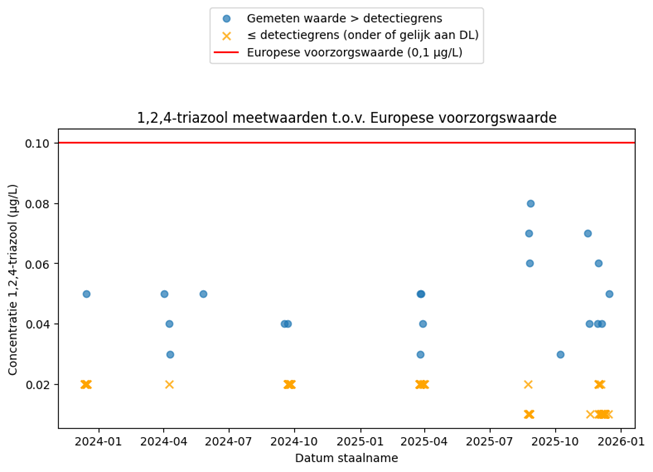
A total of 97 measurement results were analysed (December 2023 – December 2025). The measured concentrations range from 0.01 µg/L to 0.08 µg/L, with a median of 0.02 µg/L and an average of approximately 0.02 µg/L. The precautionary value of 0.1 µg/L was not exceeded in any of the samples; highest concentrations (up to 0.08 µg/L) were recorded in Middelkerke and at several monitoring points in the Ostend supply area. The vast majority of samples remained well below the precautionary limit value.
Temporary deviation from the standard
After exceedances up to 0.7 µg/L were detected in early 2024 at the De Blankaart water production centre in Diksmuide, Minister Jo Brouns granted a temporary derogation from the 0.1 µg/L limit on 20 December 2024. In the affected supply areas (De Blankaart, Zillebeke, Dikkebus and De Gavers), concentrations of 1,2,4 triazole up to 1 µg/L are permitted in drinking water until 20 December 2026, provided that no health risks are expected and remedial measures are implemented by De Watergroep.
Study by the Flemish Institute for Technological Research
Since early 2024, elevated concentrations of 1,2,4-triazole have been detected in drinking water at several water production centres (WPCs) operated by De Watergroep, with regular exceedances of the drinking water standard of 0.1 µg/L. In the context of a temporary derogation up to 1 µg/L, VITO carried out a source-identification study on behalf of De Watergroep to determine the origin of this contamination.
A literature review identified three potential sources of 1,2,4-triazole, a degradation product (metabolite) that can be formed from various triazole-based fungicides, for the relevant abstraction areas:
Human pharmaceutical use: primary care and hospitals
Pesticides: plant-protection products and biocides
Industrial discharges: process water from food and wood processing industries.
There are several ways in which 1,2,4-triazole or potential precursor compounds can enter surface water from these sources:
Direct discharges: industrial contributions
Effluent from WWTPs (wastewater treatment plants) or small-scale water purification systems: human pharmaceutical use and industry
Point sources or diffuse emissions of plant protection products, such as spray drift, run-off, erosion and drainage.
Analysis of the monitoring data from the water production centres shows substantial differences in 1,2,4-triazole concentrations in drinking water. The highest values are measured at the De Blankaart water production centre, with concentrations up to 0.7 µg/L. At the Zillebeke and Dikkebus water production centres, the drinking water standard was slightly exceeded during the summer months, partly due to increased 1,2,4-triazole concentrations during drinking water production. At the De Gavers water production centre, only a few minor instances of the drinking water standard being exceeded were recorded in early 2024.
Conclusions and recommendations
The monitoring results show that 1,2,4-triazole is present in drinking water at various locations in Flanders, but only in low concentrations. In the analysed dataset (97 measurements, covering the period from December 2023 to December 2025), no instances of the European precautionary value of 0.1 µg/L being exceeded were detected in drinking water supplied by Farys.
The highest concentration measured was 0.08 µg/L, which is well below the limit set out in the applicable standard.
The results indicate that the current concentrations of 1,2,4‑triazole in the drinking water examined for Farys do not exceed any standards. Continued monitoring remains advisable to detect potential trends in a timely manner. In addition, it remains important to monitor and, where possible, reduce potential sources – such as industrial discharges and the use of triazole-containing fungicides – to ensure the long-term safeguarding of drinking water quality.